

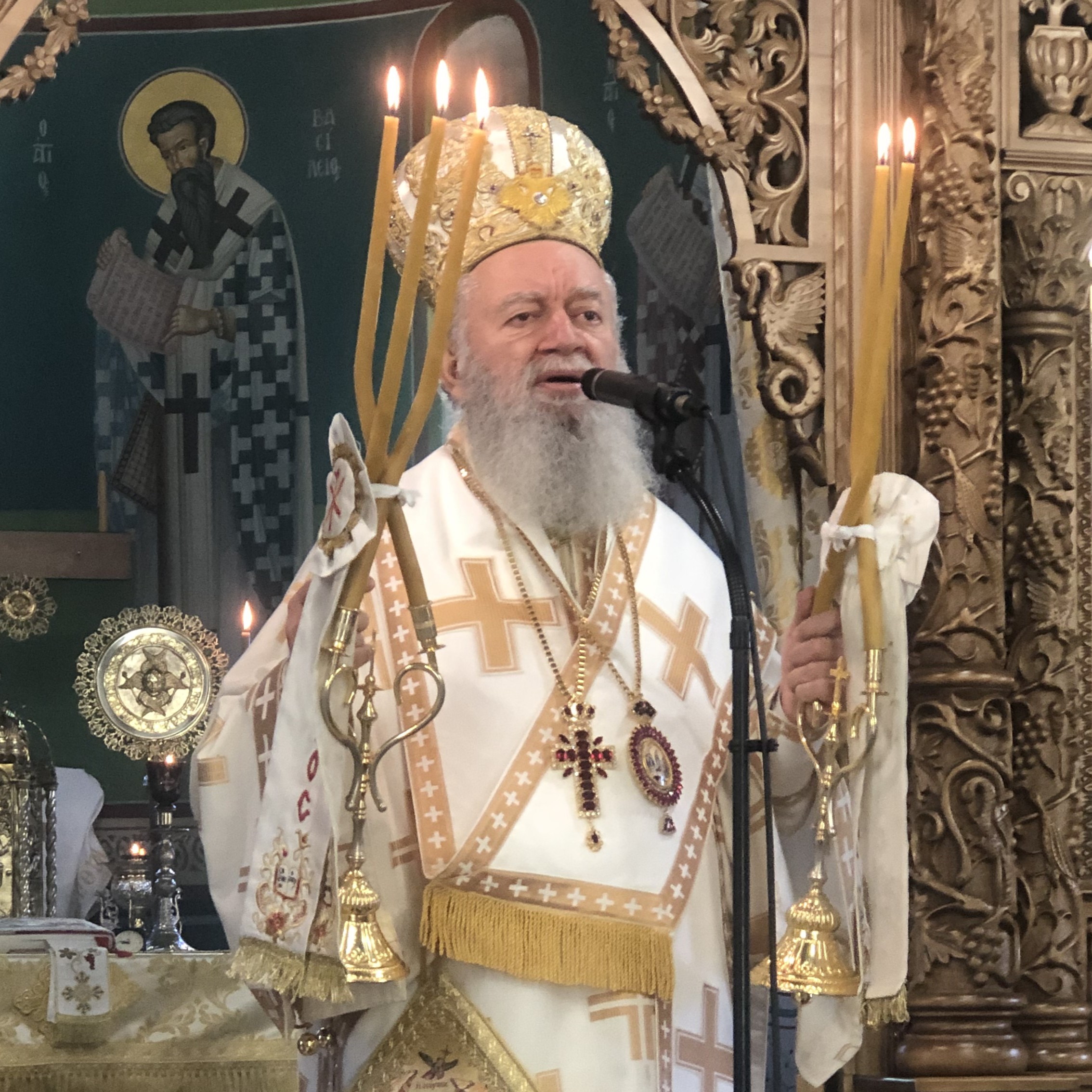
The Good Shepherd of the people’s heart.
Twenty-four years of humble, pedagogical and fruitful pastoral ministry.
(Enthronement: 12 January 2002)
By Anastasios Charmantas – Family Counselor,
Specialist in family psychodynamics,
Member of the Family Support Center of the Holy Metropolis of Chalkida.
His Eminence Metropolitan Chrysostomos of Chalkida is rightly counted among the most emblematic and distinguished figures of contemporary ecclesiastical life, with a multifaceted pastoral, theological and spiritual contribution.
Not because he holds a throne of honor, but because, through the manner of his life and ministry, he quietly won the throne of the people’s heart. From the day of his enthronement until today, over twenty-four years of pastoral ministry, he has stood not merely as the administrative head of a Metropolis, but as a father, fellow traveler and silent worker of hope, according to the model of the Good Shepherd: “The good shepherd lays down his life for the sheep” (John 10:11).
His presence does not impose itself. It brings rest. It does not sound as a voice of authority, but as a whisper of paternal tenderness. He is the shepherd who discreetly goes before the flock, allowing the traces of his love to testify more than any rhetoric. In his person, the episcopal ministry is not perceived as an office, but lived as a cross of responsibility and offering.
His pastoral ministry is characterized by gentleness, discernment and humility. He does not seek publicity. On the contrary, he consciously chooses obscurity, where true ministry bears fruit. As Saint Isaac the Syrian teaches, “the humble man becomes a cause of peace,” and this peace is tangible in the local Church, which under his fatherly guidance has become a spacious embrace of acceptance and care for every person.
His humility is not a posture, but a way of being. It is the inner silence of one who has learned to listen to the pain of the other without exposing it. From this silence the trust of the people is born—a trust not claimed, but given as a gift.
In his addresses he has boldly noted that “man has become a refrigerator to his fellow man today,” describing the coldness and indifference of our time. To this condition he sets in contrast the fire of the Church, according to the Psalm: “who makes His angels spirits, and His ministers a flame of fire.”
A flame grounded in Christ and called to melt the ice of selfishness and isolation.
A special place in his pastoral ministry is held by his reverence for the Saints of the Church, particularly Saint John the Russian, to whom he has devoted distinct ecclesiastical and theological interest, as well as noteworthy literary work. His book “Saint John the Russian, the much-enduring and champion of patience” has been presented repeatedly in Greece and abroad and translated into English and Romanian, substantially contributing to the dissemination of the sanctified figure and life of the Saint.
This theological and spiritual relationship authentically expresses the essence of ecclesiastical life as an unceasing imitation of Christ through the example of the Saints, highlighting how the experience of holiness is transformed into a source of pastoral strengthening and a rich spiritual legacy for the people of God.
I had the blessing to meet and collaborate with him immediately after his enthronement. From our first meeting I discerned not only his insight and spiritual breadth, but above all an open heart, deeply human and Christ-centered. His concern for the family, for youth and especially for children has never been theoretical or occasional. It is lived, pastoral and fatherly, rooted in the conviction that the Church must first listen and then speak.
For His Eminence, every child is not a number in pastoral statistics, but a unique person of unrepeatable value. Every family is a sacred place of struggle and hope. That is why his word touches hearts, because experience precedes it and love goes before it.
He often emphasizes that “there is no more beautiful path for one to meet Christ and the Panagia than prayer.” This word does not function as a slogan, but as testimony of personal experience. From this foundation also springs his understanding of the family as a “domestic Church,” the living nucleus of social and ecclesiastical life.
Within this spirit were born the Schools for Parents and the parent counseling groups, a long-standing and demanding work that has exceeded 9,000 hours of teaching and family support. His Eminence has been and remains present, for to him pastoral care is not a system, but a relationship.
Included in the same vision is the founding of the Radio Station of the Holy Metropolis of Chalkida. The Church enters daily life discreetly, not to impose itself, but to accompany. Parent counseling has already completed 400 broadcasts, serving as a stable point of reference for families and children, who express boundless gratitude for the spacious fatherly embrace of their Shepherd.
He also gives significant weight to the dangers of the digital world, warning about fundamentalism, syncretism and religious illiteracy. He stresses that faith is not digital information, but a lived relationship, “ecclesial communion and unity of the people around the Bishop.”
With the same fatherly care he supported and continues to support the clergy of the Metropolis. More than ninety priests were ordained in a healthy ecclesiastical climate, while several were deemed worthy to serve the Church as Hierarchs.
His social and philanthropic work has been multifaceted: Family Support Center, Food Banks, Nursing Homes, Orphanage, Camps. Behind all these stand persons toward whom the Church bends with love.
If one thing characterizes his overall course, it is the unity of word and life. He did not merely teach the Church; he lived it. He did not only speak about communion; he built it. He never stood above the people, but always beside them.
Epilogue – A Word of Gratitude and Wish
The work of His Eminence Metropolitan Chrysostomos of Chalkida was not born of ambition or the need for publicity, but from the depth of the heart and the steady exercise of paternal responsibility. It is humble work and therefore truly fruitful. It is not measured only by structures or numbers, but by hearts that were comforted, children who were inspired, clergy who were supported, and a people who learned to live the Church as mother.
We pray that God may grant him health and years under divine protection, so that the gifts entrusted to him may continue to bear fruit for the benefit of the Church. As he has always been a willing servant of His will, so also in the future, wherever divine Providence deems he may serve, may he continue to offer himself: with humility, discernment and fatherly love, to the glory of God and the blessing of His people.
Bibliography – Sources
• Holy Bible, New Testament
• John Chrysostom, On the Priesthood
• Isaac the Syrian, Ascetical Homilies
• Gregory the Theologian, Orations
• Orthodoxia News Agency,
– “Chalkida’s Chrysostomos: Church means communion”, 5.1.2026
– “Orthodox spirituality and alien ideas”, 2.12.2025
• Public speeches and pastoral messages of His Eminence the Metropolitan
• Chrysostomos of Chalkida, Saint John the Russian, the much-enduring and champion of patience (book)
 Radio Station of the Holy Metropolis of Chalkida
 Facebook
 X / Twitter
 Instagram
 YouTube